
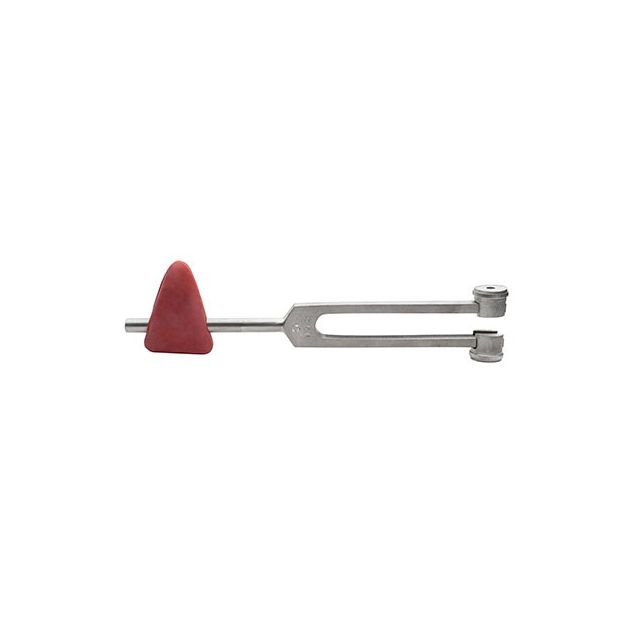
Taylor Percussion Hammer with Tuning Fork 256 cps
Details Taylor Percussion Hammer with Tuning Fork 256 cps
The Taylor percussion hammer with 256 Hz tuning fork is a versatile diagnostic instrument for objective testing of reflexes and vibration perception. With the Taylor hammer head (anvil-shaped), you reliably elicit tendon reflexes, whilst the integrated 256 Hz tuning fork is perfectly suited for assessing deep sensation and nerve function. This combination instrument saves time during examination and offers two essential testing capabilities in one ergonomic design.
Benefits of the Taylor Percussion Hammer with Tuning Fork
- Two instruments in one - combine reflex examination and vibration perception testing without changing instruments, for more efficient working
- Reliable reflex elicitation - the Taylor hammer head with anvil shape delivers a consistent percussion strike for reproducible results when testing tendon reflexes
- 256 Hz tuning fork - the optimal frequency for examining vibration perception and deep sensation, important in neuropathy and nerve lesions
- Compact and practical - easy to carry in your treatment bag or practice case, always at hand
- Robust construction - durable design for years of reliable use in clinical practice
Who is the Taylor Percussion Hammer with Tuning Fork Suitable For?
- Physiotherapists - for neurological examination and assessing reflex function in patients with movement problems
- Manual therapists - in differential diagnosis and ruling out neurological abnormalities
- Sports physiotherapists - for screening and monitoring nerve function in athletes
- Doctors and specialists - in general practice, neurology or rehabilitation medicine for quick and reliable reflex examination
- Students - for learning and practising neurological examination skills
How Does It Work?
Reflex examination with the Taylor hammer head: Hold the percussion hammer loosely and let the hammer head strike the desired tendon with a wrist movement. The anvil shape of the Taylor head ensures optimal contact surface when percussing tendon reflexes such as the patellar reflex (knee jerk), Achilles reflex or biceps reflex. Pay attention to a relaxed posture of the patient for reliable results.
Vibration perception test with the tuning fork: Strike the tuning fork by tapping it against a firm surface. Then place the foot of the vibrating tuning fork on a bony prominence, such as the medial malleolus, metatarsal head or olecranon. Ask the patient to indicate when the vibration is no longer felt. The 256 Hz frequency is clinically validated for detecting disorders of deep sensation, which is important when screening for peripheral neuropathy, nerve injury or spinal cord lesions.
Frequently Asked Questions about the Taylor Percussion Hammer with Tuning Fork
Why 256 Hz and not another frequency for the tuning fork?
A 256 Hz tuning fork (or cps) is the clinical standard for testing vibration perception and deep sensation. This frequency has an optimal vibration duration and is most sensitive for detecting disorders in the posterior columns and peripheral nerves. Lower frequencies vibrate too briefly, higher frequencies are less well perceived via bone conduction.
Which reflexes can I test with the Taylor hammer head?
With the Taylor percussion hammer you test all important tendon reflexes: patellar reflex (L3-L4), Achilles reflex (S1), biceps reflex (C5-C6), triceps reflex (C7-C8) and brachioradialis reflex (C5-C6). The anvil shape provides sufficient striking force and contact surface for reliable reflex elicitation in both superficial and deeper tendons.
Is this instrument suitable for home use or only professional use?
This percussion hammer is primarily designed for professional use by healthcare providers with knowledge of neurological examination. Correct interpretation of reflexes and vibration perception requires specialist knowledge and clinical experience. For home use, we recommend doing this only in consultation with or under the guidance of a healthcare professional.
How do I maintain the percussion hammer and tuning fork?
Clean the instrument after use with a mild disinfectant or alcohol wipe, especially when it has been in contact with the skin of multiple patients. Avoid dropping or striking the tuning fork hard, as this can affect the frequency and vibration. Store the percussion hammer in a dry place at room temperature for optimal lifespan.
Can I replace the tuning fork if it becomes damaged?
This is an integrated combination instrument where the tuning fork is permanently attached to the handle. If the tuning fork is damaged, the entire instrument will need to be replaced. With careful use and storage, the tuning fork will function reliably for many years.
What is the difference between a Taylor hammer and a Babinski hammer?
The Taylor hammer has an anvil-shaped head and is primarily used for testing tendon reflexes. A Babinski hammer has a round head with a point or needle often attached to it for testing skin reflexes and the plantar reflex. The Taylor variant is more versatile for standard reflex examination in physiotherapy.
Order your Taylor percussion hammer with 256 Hz tuning fork now and complete your neurological examination. Do you have questions about this instrument or would you like advice on additional diagnostic materials? Feel free to contact us - we're happy to help.