
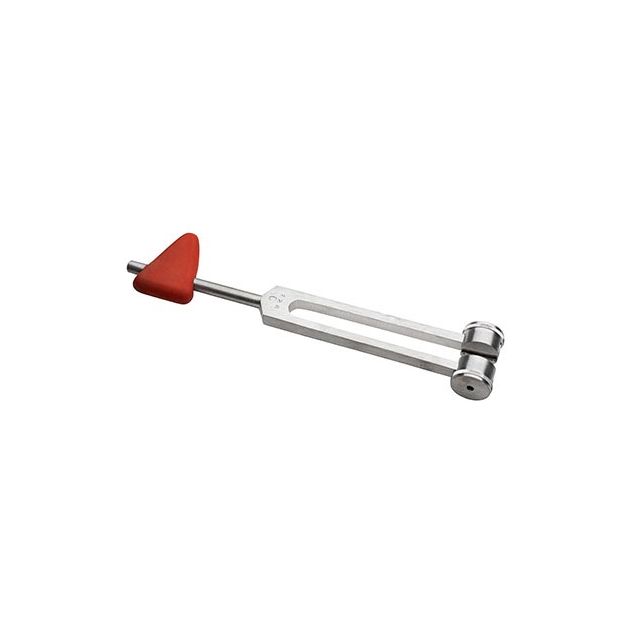
Taylor Percussion Hammer with Tuning Fork 128 cps
Details Taylor Percussion Hammer with Tuning Fork 128 cps
The Taylor percussion hammer with 128 cps tuning fork is a versatile diagnostic instrument that allows you to elicit tendon reflexes and test vibration sense during neurological examination. Thanks to the combination of a classic anvil-shaped hammer head and a precise 128 cps tuning fork, you have two essential examination instruments in one handy medical device. Ideal for physiotherapists, neurologists and general practitioners who want to perform efficient and reliable neurological function tests.
Benefits of the Taylor percussion hammer with tuning fork
- Two examination instruments in one: combining reflex hammer and vibration test in a single device saves time and streamlines your examination procedure
- Precise 128 cps tuning fork: the tuning fork vibrates at the optimal frequency for assessing deep sensibility and vibration sense
- Classic Taylor hammer head: the anvil shape delivers a targeted, consistent stimulus when eliciting tendon reflexes such as patellar and Achilles reflexes
- Professional construction: robust design for years of reliable use in clinical practice or hospital settings
- Handy and well-balanced: good weight distribution enables precise, controlled strikes without excessive force
Who is the Taylor percussion hammer with tuning fork suitable for?
- Physiotherapists and exercise therapists: for neurological examination in patients with suspected nerve or spinal cord problems
- Manual and sports physiotherapists: for screening reflex function and vibration sense following sports injuries or in chronic conditions
- Neurologists and rehabilitation physicians: for systematic reflex examination and evaluation of peripheral nerve function
- General practitioners and practice nurses: for first-line neurological screening and diabetic neuropathy detection
- Medical training institutions: for teaching clinical neurological examination
How does the percussion hammer with tuning fork work?
You use the Taylor percussion hammer by delivering a short, springy tap with the anvil-shaped hammer head to the tendon of the muscle whose reflex you wish to test. The sudden stretch of the muscle activates muscle receptors, which via the spinal cord trigger an involuntary muscle contraction. This mechanism makes it possible to assess the integrity of the reflex arc circuit (muscle receptors, nerve pathways, spinal cord). Abnormal reflexes may indicate nerve root irritation, spinal cord abnormalities or neuromuscular disorders.
You use the integrated 128 cps tuning fork by striking the instrument and then placing the vibrating end on bony prominences, for example on the medial malleolus, the big toe or the styloid process of the wrist. The patient indicates when he or she feels the vibration and when it disappears. This tests the function of thick myelinated nerve fibres responsible for deep sensibility. Reduced vibration sense may indicate peripheral neuropathy, for example in diabetes mellitus, or abnormalities in the posterior columns of the spinal cord.
Frequently asked questions about the Taylor percussion hammer with tuning fork
What is the difference between a Taylor hammer and a Babinski hammer?
The Taylor percussion hammer has an anvil-shaped hammer head that is suitable for eliciting most tendon reflexes, such as the knee and Achilles reflex. A Babinski hammer, by contrast, has a triangular rubber head and often a needle point on the handle, specifically designed for testing skin reflexes and the plantar response. The Taylor hammer is more versatile for standard reflex examination, whilst the Babinski hammer is more specialised for specific neurological tests.
Why is a 128 cps tuning fork specifically used for vibration sense?
A 128 cps (Hertz) tuning fork vibrates at the optimal frequency to activate Pacini corpuscles, the receptors responsible for perceiving vibration and deep pressure. This frequency is low enough to produce a noticeable vibration for a sustained period, giving you sufficient time to perform the test correctly. Higher frequencies such as 256 or 512 cps vibrate too quickly and fade too rapidly for reliable vibration sense testing.
How often should I replace a percussion hammer?
A professional percussion hammer of good quality will last for many years with normal use. Replace the instrument when the hammer head is visibly damaged, the handle becomes loose, or when the tuning fork no longer vibrates purely. For hygiene purposes, regularly check that all components are secure and clean the instrument according to medical device guidelines. With intensive use in a busy practice, replacement may be necessary after several years.
Can I use the tuning fork for other tests?
Yes, in addition to testing vibration sense, you can also use a 128 cps tuning fork for the Rinne test and Weber test in hearing examination, although 512 cps tuning forks are often preferred for these due to their sharper pitch. However, the 128 cps tuning fork is primarily optimised for assessing proprioception and deep sensibility, and this is also the most common application in physiotherapy and neurology practice.
How do I perform a correct reflex test with the Taylor hammer?
Ensure the patient is relaxed whilst sitting or lying down, and allow the muscle to be tested to come into a slightly stretched but not tense position. Hold the percussion hammer loosely at the end of the handle and allow your wrist to move freely, so the hammer strikes with a smooth, short swing. The force comes from the wrist movement, not from your whole arm. Tap directly on the tendon, not on the muscle itself. Always compare left with right and assess whether the reflex is normal, brisk, diminished or absent. With absent reflexes, you can apply the Jendrassik manoeuvre (patient pulls hands together) to make a hidden reflex visible.
Is this percussion hammer suitable for home use?
This Taylor percussion hammer with tuning fork is a professional diagnostic instrument and is primarily intended for use by trained healthcare professionals such as physiotherapists, physicians and other medical professionals. Correct performance and interpretation of reflex examination and vibration sense testing requires professional knowledge and experience. Home use without medical training is therefore not recommended, as improper application can lead to incorrect conclusions. If you have concerns about reflex function or sensation? Then always consult your general practitioner or physiotherapist.
Expand your examination instrument repertoire with this versatile Taylor percussion hammer and perform reliable neurological tests. Order today and enhance the quality of your clinical examination.