
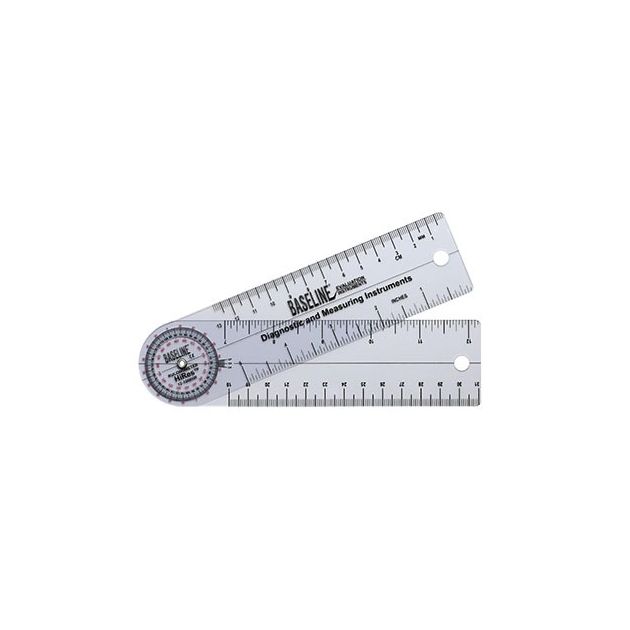
Baseline Plastic Goniometer 360° - Ruler 15 cm
Details Baseline Plastic Goniometer 360° - Ruler 15 cm
This transparent plastic goniometer from Baseline combines accurate joint measurement with ease of use. Thanks to the transparent design, you can directly observe the axis of movement and the full range of motion of a joint. The unique white line behind the measurement scale ensures you can read values quickly and accurately, even during repeated measurements throughout treatments.
Advantages of the Baseline Plastic Goniometer
- Improved reading accuracy: white line behind the measurement scale makes reading easier and prevents measurement errors
- ISOM-calibrated: three scales according to International Standards of Measurement (SFTR) for standardised measurements
- Transparent design: clear plastic for direct placement on joint or limb without visual obstruction
- Multifunctional measurement scales: linear scale in centimetres and inches on both arms for versatile use
- Stable arm position:arms remain in measured position until you actively reset them, useful for documentation
- Durable and hygienic: sturdy plastic suitable for frequent use in practice and home settings
Who is the Baseline Goniometer suitable for?
- Physiotherapists and manual therapists: for ROM measurements (Range of Motion) during intake and treatment evaluation
- Sports physiotherapists: for injury recovery and progress monitoring in athletes
- Rehabilitation professionals: for objective measurement of recovery after surgery or trauma
- Occupational therapists: for functional assessment of joint mobility in daily activities
- Home care workers and carers: for monitoring range of motion in elderly or patients with chronic conditions
- Healthcare students: for learning correct measurement techniques and documentation
How does the goniometer work?
The goniometer measures the range of motion (ROM - Range of Motion) of a joint by determining the angle between two body parts. The 360° head forms the pivot point and is placed on the axis of movement of the joint. You place the two 15 cm arms along the adjacent body parts, for example the lower and upper leg when measuring the knee.
Thanks to the ISOM system (International Standards of Measurement - SFTR), you measure according to standardised protocols. The three calibrated scales on the 360° head enable you to accurately document extension, flexion, abduction, adduction and rotation of joints. The scale reads in increments of 1°, which is sufficiently precise for clinical application.
The linear scales on both arms are additionally functional: with these you can measure not only angles, but also lengths and distances in both centimetres and inches. This makes the goniometer versatile for use with various measurement protocols. The transparent material ensures you can continue to see the anatomical landmarks (bony landmarks) clearly during measurement, which increases reliability.
Frequently asked questions about the Baseline Plastic Goniometer
What is the difference between this goniometer and a standard model?
The main difference lies in the white line behind the measurement scale, which makes reading considerably easier. In addition, the three scales on the 360° head are specifically calibrated for the ISOM system (SFTR), which makes this goniometer suitable for standardised measurements according to international protocols. The ruler model with 15 cm arms combines angle and length measurement in one instrument.
How do I clean and disinfect this plastic goniometer?
You can easily clean the plastic goniometer with a damp cloth and mild soap or an alcohol-free disinfectant wipe. Avoid aggressive cleaning agents and autoclaving, as this can damage the plastic or cause the measurement scales to fade. For use in practices with multiple patients, we recommend cleaning between each patient according to your own hygiene protocol.
Is this goniometer suitable for all joints?
With 15 cm arms, this goniometer is suitable for most small to medium-sized joints, such as elbow, wrist, ankle, knee and shoulder. For very small joints (fingers, toes) or very large joints (hip in larger patients), a model with shorter or longer arms may be more suitable. The 360° head enables measurement in all planes.
Why is ISOM calibration important in joint measurement?
ISOM stands for International Standards of Measurement and is linked to the SFTR system (Sagittal, Frontal, Transversal, Rotation). This standardised measurement method ensures that measurements between different therapists, moments and locations are comparable. This is essential for reliable progress evaluation, scientific research and uniform reporting in medical records.
Can I also measure lengths with this goniometer?
Yes, both arms are equipped with a linear scale with centimetres and inches. With this you can measure not only angles but also lengths and distances, for example leg length differences, circumference of swelling or distances between anatomical points. This makes the instrument versatile for use during a comprehensive physical evaluation.
How do I document measurements reliably with this goniometer?
The arms automatically remain in the measured position until you reset them. This gives you time to calmly read and note the value before carrying out the next measurement. For optimal reliability, we recommend always performing measurements twice and working according to fixed protocols, with clear notation of starting position, direction of movement and measured value.
Order your Baseline plastic goniometer today and measure joint range accurately and reliably. Do you have questions about the right model or application? Please feel free to contact us for personal advice.