
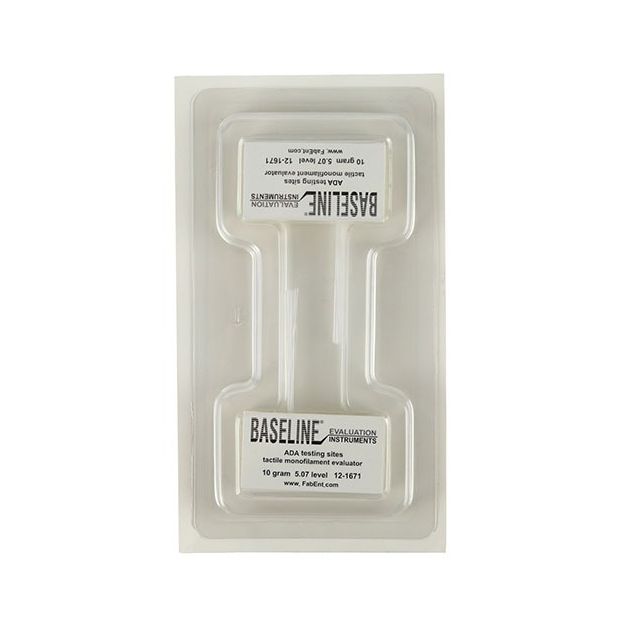
Baseline Monofilament 10 g - ADA, Disposable (40 pcs)
Details Baseline Monofilament 10 g - ADA, Disposable (40 pcs)
The Baseline Tactile Monofilament according to the ADA programme is a reliable diagnostic tool for detecting loss of protective sensation and screening for peripheral neuropathy. This disposable version of 5.07 / 10 gram is specifically designed for assessing the neurological status of the foot and helps you identify risks of diabetic foot complications in good time.
Benefits of the Baseline Tactile Monofilament
- Hygienic and safe: disposable version prevents cross-contamination between patients, ideal for clinics and practices with high patient flow
- Evidence-based: follows the standardised ADA test protocol (American Diabetes Association) with clear test locations for consistent results
- Reliable force: standardised pressure of 5.07 / 10 gram for reproducible sensitivity measurements
- Practical packaging: 40 individual monofilaments in hygienic blister packaging, ready to use
- Complete protocol: comes with test instructions and anatomical test locations according to ADA guidelines
- Early detection: signals changes in neurological status before serious complications develop
Who is the Baseline Tactile Monofilament suitable for?
- Diabetes nurses and podotherapists who regularly perform foot screening
- Physiotherapists and manual therapists who map peripheral nerve damage
- General practice surgeries and diabetes clinics with active diabetes care
- Wound centres and home care organisations for risk monitoring in diabetes patients
- Rehabilitation centres that evaluate neurological recovery after trauma or conditions
- Neurologists and specialists who diagnose peripheral neuropathy
How does it work?
The Baseline Tactile Monofilament tests whether a patient has protective sensation in the foot. The monofilament is a thin nylon fibre with a paper handle that bends at a standardised pressure of 10 gram. This specific force of 5.07 / 10 gram marks the threshold below which the risk of foot ulcers increases significantly in diabetes patients.
During the test, you place the monofilament perpendicular to the skin at predetermined test locations according to the ADA protocol, usually on the plantar side of the foot. You apply pressure until the filament bends and hold it for approximately 1-2 seconds. The patient indicates whether they feel the touch, without visual contact. If the patient does not feel the touch at two or more test locations, this indicates loss of protective sensation and increased risk of foot complications.
The supplied ADA test protocol describes exactly which anatomical locations you should test and how to interpret the results. By systematically testing these fixed points, you get a reliable picture of the sensitivity status and can monitor changes over time.
What's in the box?
- 40 sterile disposable monofilaments of 5.07 / 10 gram in blister packaging
- ADA test protocol with standardised test procedure
- Overview of anatomical test locations according to ADA guidelines
- Each monofilament provided with paper handle for hygienic use
Frequently asked questions about the Baseline Tactile Monofilament
Why use a disposable monofilament instead of a reusable version?
Disposable monofilaments guarantee optimal hygiene and eliminate the risk of cross-contamination between patients, which is essential in clinics with multiple patients per day. Moreover, the test force remains reliably accurate because each filament is used only once, without the risk of material fatigue that could affect measurement accuracy.
What does 5.07 / 10 gram mean in monofilament testing?
The number 5.07 refers to the logarithmic scale (log 0.01 gram = 10 gram force). This specific pressure of 10 gram marks the clinically relevant threshold: patients who no longer feel this pressure have a significantly increased risk of foot ulcers and other diabetic foot complications. This makes the 10 gram monofilament the standard in diabetic foot screening worldwide.
How often should you perform monofilament testing in diabetes patients?
According to international guidelines, it is recommended to screen diabetes patients at least annually for loss of protective sensation. For patients at higher risk (previous ulcers, foot deformities, or already demonstrated neuropathy), six-monthly or even three-monthly screening is advisable to detect deterioration in good time.
Which locations do you test according to the ADA protocol?
The ADA protocol usually describes 4 to 10 test locations on the plantar side of the foot, including the great toe (hallux), metatarsal heads 1, 3 and 5, and sometimes the heel. You test bilaterally and avoid calluses, corns or scars as these can distort sensation. The protocol supplied with these monofilaments specifies exactly which points you should test.
Can these monofilaments also be used for other neurological tests?
Yes, although they are primarily developed for diabetic foot screening, these monofilaments are also suitable for mapping peripheral nerve damage in other conditions such as carpal tunnel syndrome, ulnar nerve compression or after traumatic brain injury. They help you objectively monitor changes in neurological status during the rehabilitation process.
What is the advantage of a 40-pack for my practice?
The 40-pack provides a supply for approximately 40 individual patient tests, which for most practices represents a practical inventory for several weeks to months. The blister packaging keeps each monofilament sterile and protected until use, so you always have guaranteed reliable test materials on hand without frequent reordering.
Order the Baseline Tactile Monofilament 40-pack today and perform reliable diabetic foot screening according to the evidence-based ADA protocol. Do you have questions about the application or would you like advice on other neurological test materials? Feel free to contact us.