
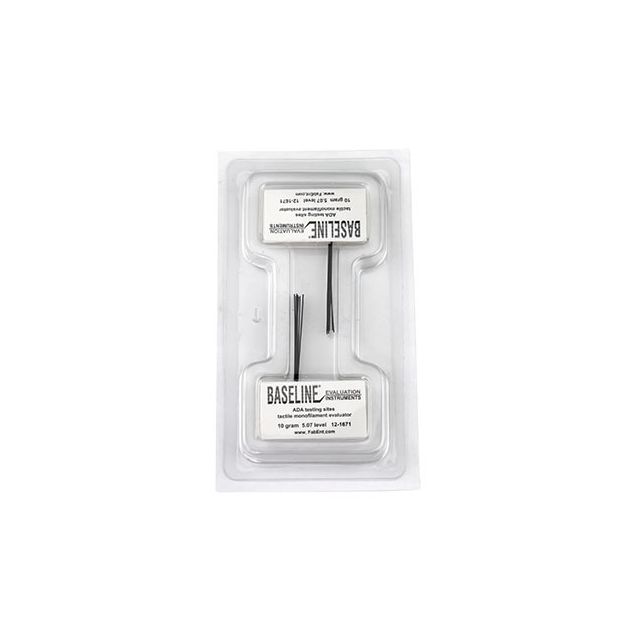
Baseline Monofilament 10 g - ADA, Disposable (20 pcs)
Details Baseline Monofilament 10 g - ADA, Disposable (20 pcs)
The Baseline Tactile Monofilament is a diagnostic tool for detecting loss of protective sensation and peripheral neuropathy, particularly in patients with diabetes or other nerve disorders. With a calibration of 5.07 (10 gram pressure), you follow the ADA protocol (American Diabetes Association) for reliable screening. Each monofilament is for single use, hygienically packaged and ready to use immediately in clinical practice, hospital or home care settings.
Benefits of the Baseline Tactile Monofilament
- Reliable screening according to ADA guidelines: the 5.07 calibration (10 gram) is the international standard for neuropathy detection
- Hygienic and safe: each monofilament is individually packaged for single use, ideal for multiple patients without cross-contamination
- Early detection: helps identify changes in neurological status in good time, so you can intervene preventively
- Complete test support: includes test protocol and overview of recommended test locations on the foot
- Practical to use: paper handle makes the monofilament easy to handle and ready to use immediately
- Cost-effective: 20 pieces per pack, suitable for outpatient clinics, physiotherapy practices, diabetes clinics and podology
Who is the Baseline Tactile Monofilament suitable for?
- Diabetes clinics and hospitals: periodic screening for diabetic foot syndrome and loss of protective sensation
- Physiotherapists and manual therapists: examination of nerve function in patients with neuropathy, radiculopathy or after neurosurgery
- Podotherapists and pedicurists: early detection of sensory disorders in at-risk feet
- Rehabilitation centres: monitoring of sensory recovery after trauma, surgery or neurological conditions
- Home care and community nursing: simple, hygienic screening in vulnerable elderly and chronically ill patients
- Research and education: standardised test material for scientific research and teaching
How does the monofilament work?
The monofilament consists of a thin nylon filament that bends at a predetermined pressure (10 gram). You place the monofilament perpendicular to the skin at prescribed test locations on the sole of the foot (usually at the level of the metatarsal heads and hallux). When the patient does not feel the touch, there is reduced or absent protective sensation. This increases the risk of unnoticed wounds, ulcers and infections.
The test protocol follows ADA guidelines: you test at least four to ten fixed points per foot, ask the patient to close their eyes and indicate where and when touch is felt. Reduced response indicates neuropathy and calls for further diagnostics or preventive measures such as adapted footwear, patient education and regular foot inspection.
What's in the box?
- 20 tactile monofilaments of 5.07 / 10 gram, each individually packaged with paper handle
- Test protocol and overview of recommended test locations according to the ADA programme
Frequently asked questions about the Baseline Tactile Monofilament
What does the calibration 5.07 / 10 gram mean exactly?
The 5.07 refers to the logarithmic scale of force (log 0.1 gram = 5.07), which corresponds to a pressure of 10 gram. This is the international standard for detecting loss of protective sensation in diabetic neuropathy, as recommended by the American Diabetes Association.
Are these monofilaments really for single use only?
Yes. After one test application, the filament loses its calibration and can give unreliable results. Disposable monofilaments guarantee hygiene and accuracy, especially important when screening multiple patients in a clinical setting.
Can I use the monofilament for neuropathy other than diabetic foot?
Certainly. The monofilament is suitable for any form of peripheral neuropathy: chemotherapy-induced neuropathy, radiculopathy, post-traumatic nerve damage or neurological conditions such as MS. The test protocol remains the same, but you may adjust the test locations to the affected dermatome or nerve distribution.
How often should I screen for neuropathy in diabetic patients?
Current guidelines recommend annual screening in all people with diabetes, and more frequently (every three to six months) in patients at higher risk, such as those with a previous ulcer, foot deformity or poorly controlled diabetes. Early detection prevents complications.
What is the difference between disposable and reusable monofilament?
Reusable monofilaments are more durable but require cleaning and tend to lose calibration after frequent use. Disposable monofilaments are more hygienic, more reliable per test and ideal for environments with high patient throughput. For a practice with many screenings, the 20-pack is cost-effective.
Can I also test other locations than the foot?
Yes. The monofilament is also suitable for testing sensation in hands, forearms or other skin areas where you suspect neuropathy. However, adjust the standards accordingly: the ADA protocol is specific to the foot, other areas sometimes require a different interpretation of the results.
Order the Baseline Tactile Monofilament 20-pack today and ensure reliable, hygienic screening for neuropathy in your practice. Do you have any questions or would you like advice on the correct application? Feel free to contact us.