
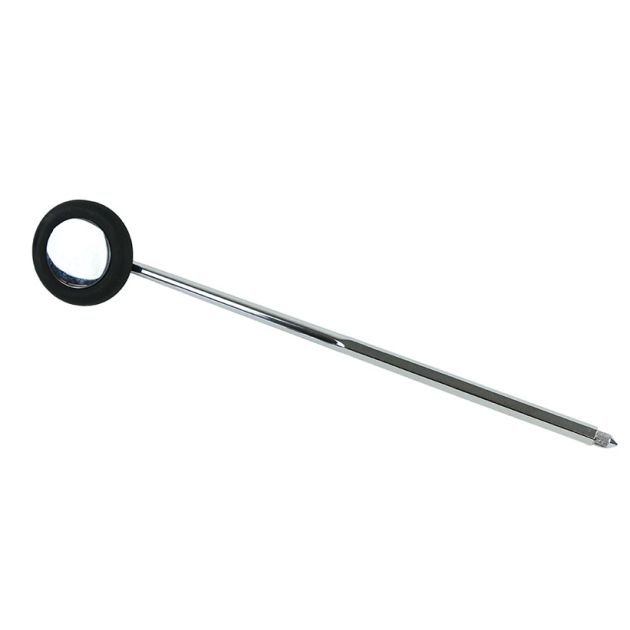
Babinski Reflex Hammer with Long Handle
Details Babinski Reflex Hammer with Long Handle
The Babinski Percussion Hammer with Extended Handle is a versatile diagnostic instrument for accurately eliciting and assessing reflexes during neurological examination. Thanks to the adjustable percussion head, extended ergonomic handle and integrated esthesiometer, this reflex hammer is suitable for physiotherapists, neurologists, general practitioners and other healthcare professionals performing precise neurological function tests.
Benefits of the Babinski Percussion Hammer with Extended Handle
- Adjustable percussion head, the reflex head can be directed in two directions for optimal angle adjustment in different reflex examinations (tendon reflex, skin reflex)
- Extended handle, provides excellent leverage and control, especially for deep tendon reflexes such as the Achilles reflex
- Dual function, the pointed underside serves as a rough esthesiometer for testing superficial sensitivity and skin stimuli
- Accurate reflex elicitation, the well-balanced design enables controlled, reproducible percussion strikes
- Durable material, robust construction for long-term intensive use in practice or clinic
Who is the Babinski Percussion Hammer suitable for?
- Physiotherapists and manual therapists, for neurological function examination and ruling out radicular problems
- Neurologists and rehabilitation physicians, for detailed reflex diagnostics and follow-up of neurological conditions
- General practitioners and practice nurses, for basic neurological examination in primary care
- Medical and physiotherapy students, for learning correct examination techniques and reflex diagnostics
- Home care professionals, for neurological monitoring in patients with chronic conditions
How does the Babinski Percussion Hammer work?
The percussion hammer is used to elicit reflexes by performing a short, controlled tap on a tendon or muscle. This activates the reflex arc: sensory receptors (muscle spindles) register the stretch, the signal travels via the spinal cord back to the muscle, which then contracts. The response provides information about the integrity of the nervous system.
With this Babinski hammer, the percussion head is adjustable in two directions, allowing you to select the optimal angle for different tendon reflexes such as the biceps reflex, triceps reflex, patellar reflex or Achilles reflex. The extended handle provides sufficient leverage, essential for effectively eliciting deeper reflexes.
You use the pointed underside of the hammer as a rough esthesiometer: by gently stroking across the skin or lightly pricking, you can test superficial sensitivity. This is relevant when examining dermatomes, ruling out sensitivity disorders or eliciting pathological reflexes such as the Babinski reflex itself.
Frequently asked questions about the Babinski Percussion Hammer
Why does this reflex hammer have an adjustable head?
The adjustable head allows you to optimally tailor the percussion direction to the anatomy and the reflex area being examined. For some reflexes, such as the Achilles reflex in a seated patient, a different angle is needed than for the patellar reflex. The adjustable head saves time and increases the accuracy of your examination.
What is the difference between a Babinski hammer and a standard reflex hammer?
A Babinski percussion hammer typically has a longer shaft and an adjustable head, making it more versatile than a classical Taylor or Tromner hammer. Moreover, the Babinski hammer often features a pointed end for sensitivity examination. It is ideal for those who want to combine both reflex and sensitivity tests within one instrument.
How do I use the pointed underside as an esthesiometer?
You use the pointed underside to test superficial sensitivity. Gently stroke across the skin or lightly prick (without injuring) to assess whether the patient feels the stimulus and can localise it correctly. This helps in mapping dermatomes, detecting sensitivity disorders and eliciting skin reflexes such as the abdominal reflex or the plantar reflex (Babinski sign).
Which reflexes can I examine with this hammer?
With the Babinski percussion hammer you can examine all important tendon reflexes: biceps reflex (C5-C6), triceps reflex (C7), brachioradialis reflex (C5-C6), patellar reflex (L3-L4) and Achilles reflex (S1). In addition, with the pointed end you can elicit skin reflexes and the Babinski reflex, essential for detecting central nervous system lesions.
Is this percussion hammer also suitable for home use or only for professionals?
This reflex hammer is primarily designed for professional use by healthcare providers with knowledge of neurological examination techniques. Correct interpretation of reflexes requires professional expertise and experience. For home use, we recommend first receiving instruction from a physiotherapist or doctor.
How do I maintain the Babinski Percussion Hammer?
Clean the hammer after use with a mild disinfectant or alcohol wipe, especially when direct skin contact has occurred. Regularly check that the adjustable head is secure and moves smoothly. Store the hammer in a dry place at room temperature. For intensive use in a clinical setting, we recommend periodic inspection for wear.
Invest in accurate neurological diagnostics. Order the Babinski Percussion Hammer with Extended Handle today and experience the difference in precision and ease of use during your neurological examinations.